
Showing posts with label collecting. Show all posts
Showing posts with label collecting. Show all posts
Friday, June 28, 2013

Wednesday, June 26, 2013

Saturday, June 15, 2013


Tuesday, March 26, 2013

Tuesday, March 19, 2013

Tuesday, March 12, 2013
WINSLOW'S SOOTHING SYRUP

This was a very long lasting product despite there being quite a bit of evidence that it could be fatal to babies. It was extensively advertised with trade cards and newspaper ads.
Tuesday, March 5, 2013
19TH CENTURY CASTORIA CARD
Jumbo was a very famous Elephant owned by PT Barnum in the 1880's, in fact the word Jumbo, meaning large, can be traced back to the circus elephant.


Tuesday, February 26, 2013

Friday, September 7, 2012

Wednesday, September 5, 2012
MURPHY BED
A convertible bed with a mirror on it doesn't seem very safe and it also looks very heavy, but maybe it was very sturdy and safe, just not very practical.


Monday, September 3, 2012
SPECIALTY STOVE POLISH TRADE CARD
The front and back side of a card that illustrates the high shine possible with this particular stove polish.


Sunday, June 24, 2012


Friday, June 22, 2012


Wednesday, June 20, 2012
Collecting Advertising trade cards
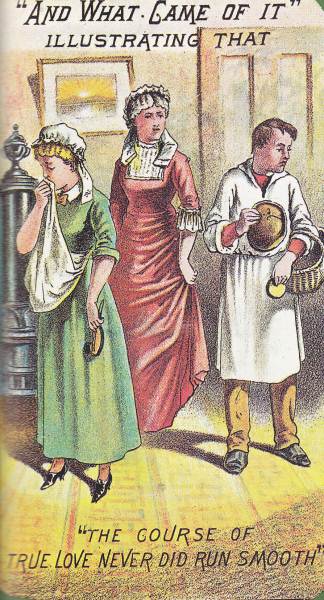
 Starting in about the 1860's manufacturers began producing and giving away millions of trade cards. The front would have an attractive picture, almost always in color, and the back would have an advertising slogan and often the name of the local store where the product could be purchased.
The cards were intended for consumers, but they became very popular with children. The cards were collected and traded by children. Often even adults had their own collection, some going so far as to paste the cards in albums to show off to friends.


Monday, June 18, 2012
Origin of Baseball Cards
 Baseball cards started from advertising trade cards. These small color cardboard designs were used to promote products and businesses and were extremely popular. The cards were avidly collected, especially by children. The cards were made of cardboard and were a little bigger than playing cards.
On the front side was a color image that might have a little bit of advertising on it. On the back of the card was were the bulk of the text was written. Usually the name of the product, its uses and where it could be purchased. Some stores also had their own cards and they would list address and available products on the back.
 When baseball became popular, after the Civil War, images of the game and players started to appear in the ads. The cards didn’t necessarily have anything to do with baseball, the ads usually included whatever was popular at the time whether or not it had anything to do with the product.
In 1868 the first trade cards that advertised baseball related items were produced. Pick and Synder, a sporting goods store in New York started to produce trade cards featuring teams. These were not exactly baseball cards; the images were of teams not individual players.

 By the mid 1880’s cigarette manufacturer, Old Judge Tobacco started putting images of individual players in their cigarette packs. Cardboard was put in the packs anyway, to strengthen the package, so they might as will put ads on them. The cards proved quite popular and were soon included in chewing tobacco products as well. Piedmont, Polar Bear and other cigarette makers soon followed suit. Cards were also an early prize in Cracker Jack boxes.
So baseball cards were actually popular before there was professional baseball. The cigarette cards continued until the 1920’s. In 1933 baseball cards reappeared, but this time not with cigarettes. The cards were packaged with bubble gum, first by the Goudey Gum Co. Their first set of cards included Babe Ruth and Lou Gehrig. The cards included a picture of a player and baseball information, but not stats .
 The additional player information wasn’t added to the cards until 1952, but even before then they were widely collected. There was a lull during WWII, when the cards were unavailable due to wartime restrictions. But after the war, Bowman Gum, Leaf Candy Company and Topps Gum Company started reissuing cards.
Leaf quickly stopped producing cards ,but Bowman was very popular in the late 1940’s and early 1950’s. But Topps eventually bought out Bowman and offered the most popular cards. All Star cards were first issued in 1958 and Record Breakers cards in 1975.
 You may not think of baseball cards as big business but they certainly are. Topps had a virtual monopoly on cards and other card manufacturers had to sue to get access to the players, most of whom were under exclusive contract to Topps. Since Topps lost the lawsuit other brands have produced cards and baseball cards are still avidly collected. Topps also produces cards for other sports.
Subscribe to:
Posts (Atom)